Operationalized Machine Learning in Healthcare
Lec 1: From a clinical need to a monitored, accountable system
DGIN 5401 · Dalhousie University
Course, studio, and the clinical question
What this course is about
This is a seminar and research course about a subtly difficult question:
What would have to be true for a machine-learning system to actually improve healthcare?
Clinical purpose
What care gaps, risks, or inefficiencies exist a priori?
Honest evidence What designs, comparisons, metrics, and measures of uncertainty must be applied?
What would be convincing? What wouldn’t be?
Sociotechnical fit
How do the model, interface, workflow, people, and incentives work together as one?
Lifecycle responsibility
How do we monitor, investigate, update, roll back, and retire when the context changes?
How we will work together
Seminar
- read current work as collaborators (and critics);
- teach papers so that a mixed audience can follow;
- identify the important contribution and the hidden weakness;
- distinguish a remarkable result from an overclaim.
Research Studio
- work from a shared cardiac-surgery context;
- produce reusable project artifacts in stages;
- compare assumptions across clinical, technical, and operational lenses;
- aim for work that could survive serious peer review.
Administrative details
Dates, assessment weights, communication channels, and current policies live in the syllabus and MS Teams. This deck concentrates on how to do the work well.
Course mechanics at a glance
Small seminar
Discussion, peer teaching, and flexibility are (expected) features.
Research communication
Expect conference-style paper presentations, questions, and concise reflections.
Shared studio
Staged artifacts build toward rigorous project work, with clear individual ownership inside a collaborative theme.
Working record
Use MS Teams for communication and submitting checkpoints; keep code, sources, data decisions, and environments reproducible, shared on 🔗 GitHub.
Preparation is participation
Arrive ready to question, explain, and collaborate. Attribute ideas, text, figures, code, and data precisely to outside sources (including generative ones), and to each other.
How to use the deck
Move through the argument
- ↔︎️ horizontal navigation follows the main narrative;
- ↕️ vertical navigation opens a section or related depth;
oopens the overview;- some code is executable.
A recurring learning rhythm:
Question → inspect → test → interpret
- state the clinical or analytical question;
- inspect how the data or evidence were produced;
- test an expectation with code, a plot, a model, or a design;
- state what the result supports, and what it does not.
What you should be able to do
By the end of this course, you should be able to:
- turn a clinical concern into a precise, contestable intended use;
- trace how healthcare becomes data and locate distortions in that path;
- construct a reproducible baseline and a defensible validation plan;
- evaluate discrimination, calibration, thresholds, uncertainty, time, and subgroup performance;
- reason about rare events, errors, privacy, intervention effects, et c; and
- describe the human workflow, monitoring, governance, and accountability required after prediction.
The standard
The aim is to be able to make decisions and claims with clear rationale.
All expertise is valid here
- Clinical: workflow, outcomes, harms, actionability
- Data: provenance, measurement, missingness, labels
- Model: assumptions, optimization, generalization
- Evidence: design, metrics, uncertainty, validity
- Human: trust, usability, equity, accountability
- Deployment: integration, monitoring, rollback, retirement
Pause and discuss
Which lens is already closest to your expertise? Which lens will you deliberately practise this term?
Project component
Reasons for One Big Project
- We all bring something unique to the table;
- I would like to introduce more ‘project management’ in ML+Health into the course;
- This includes more transparency and robustness;
- I would like the end result not to be a set of disconnected projects, but one relatively major contribution.
AIRO provides a common context
🔗 AIRO is an initiative at our QEII hospital that explores dynamic risk assessment and outcome optimization in cardiac surgery, using the 🔗 Maritime Heart Centre Registry as a clinical-data resource.
What is shared
- a clinical setting;
- a care pathway;
- a registry and its limitations;
- collaborators and real constraints.
What remains open
- the outcome and prediction time;
- the intended user and action;
- the appropriate method;
- the evidence needed for a defensible claim;
- how to monitor a deployment.
What you will lead
- own a tractable question;
- justify why it matters and what gaps remain (i.e., from literature review);
- make assumptions and plan visible (i.e., through a methodology);
- perform comparisons and analysis, and follow the research (i.e., through experiments)
- connect your work to the larger system.
One patient journey, many questions
Clinical case
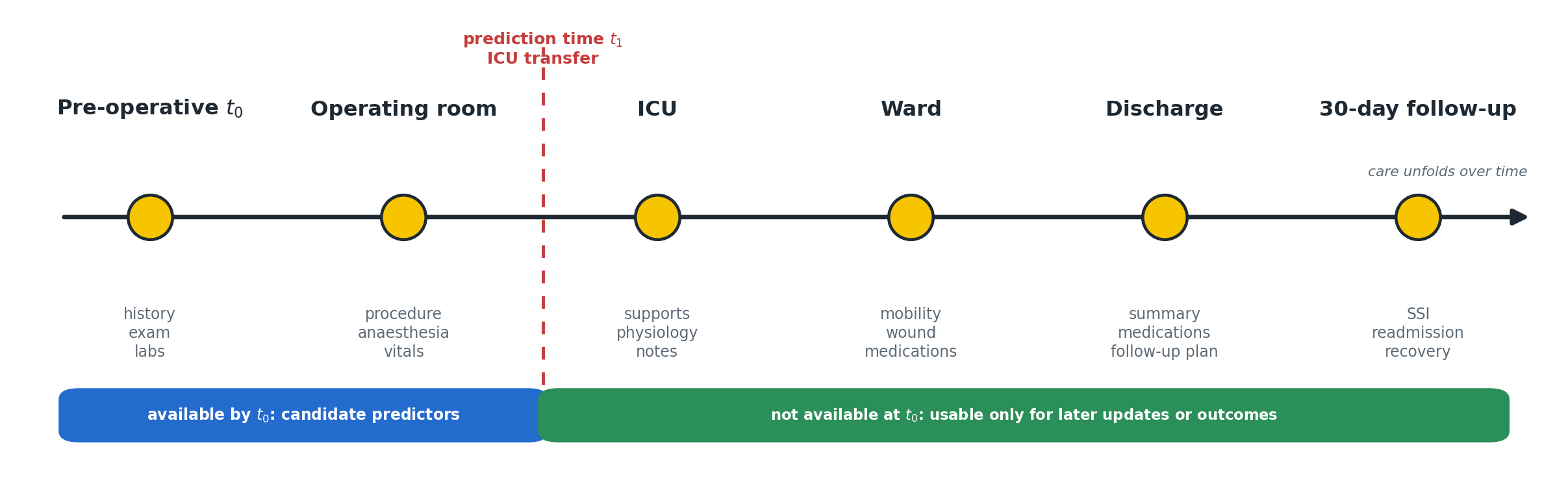
An adult patient undergoes cardiac surgery. Information arrives across pre-operative assessment, the operating room, ICU, ward, discharge, and 30-day follow-up.
Our recurring outcome is 🔗 delirium (or, alternatively, surgical-site infection (SSI); see handouts), with related examples involving mortality, acute kidney injury, prolonged ventilation, readmission, and recovery.
The case is inspired by the AIRO cardiac-surgery project, but the patient, notes, and values in this deck are educational and synthetic.
Some questions we keep asking
- Who is the intended population and user?
- When is the prediction made, and what information exists then?
- What outcome is being estimated, over what scope?
- Why would the estimate change care or operations?
- Why did the model behave the way it did?
- How will usefulness, safety, and equity be evaluated?
- How will the environment, data, or model change?
Evidence
See guidance on reporting, risk-of-bias, early clinical evaluation, and lifecycle guidance such as TRIPOD+AI (Collins et al. 2024), PROBAST+AI (Moons et al. 2025), DECIDE-AI (Vasey et al. 2022), and FUTURE-AI (Lekadir et al. 2025).
An example individual research claim
Among adult cardiac-surgery patients, use information available by ICU transfer to estimate the probability of superficial surgical-site infection within 30 days, so that the postoperative team may consider enhanced surveillance and follow-up.
This is just a starting point. We’ll discuss and might pivot slightly through the class. Testing and re-evaluating whether the patients, timing, labels, actions, and evidence make sense is good; we want to be flexible, within reason.
🤔 Contribution idea
A useful project contribution may be to show that one of these choices has a strong statistical effect on another.
How project questions are claimed
1 · Explore
Review the data and example contributions.
2 · Register
Enter up to three ranked interests—or propose a new question—in the pinned Research Topic Registry in MS Teams.
Due: 16 September
3 · Reconcile
We compare feasibility, scope, dependencies, coverage, and learning goals. Overlapping interests may become complementary questions.
17-18 September
4 · Confirm
Submit a one-page question card. Leadership becomes confirmed after feasibility and scope review.
With proposal: 21 September
Not ‘first come, first served’
All preferences received by the deadline are considered together. The aim is a fair set of feasible, complementary contributions—not a race to claim a broad topic.
One formal rescoping point follows the dataset-analysis checkpoint. A question may change when the data reveal a genuine feasibility problem; the reason and revised scope are recorded in the registry.
What makes a research question claimable
The question card identifies
- the one-sentence research question;
- why it matters;
- the population, time, outcome, or object of study;
- the intended contribution or claim;
- the data and evidence required;
- the comparator and evaluation plan;
- dependencies, risks, and a fallback.
What makes a research question claimable
Too broad
“Use deep learning for surgical-site infection.”
Claimable
“Does adding information from the first 12 ICU hours improve calibration of 30-day superficial-SSI risk beyond an end-of-surgery baseline, without temporal leakage or unacceptable missingness?”
“Which perioperative missingness patterns reflect clinical workflow, and how do they change apparent SSI-model performance?”
Leadership, not exclusivity
The named lead is accountable for moving the question forward and documenting the work. Shared data, infrastructure, reusable code, and adjacent scientific ideas remain shared; contributions and dependencies are recorded explicitly.
The term is one growing research paper
Proposal
Introduction, intended use, question, hypotheses, evidence plan, and feasibility risks.
Literature review
Related work, evidence map, strongest baselines, external validations, and the unresolved gap.
Dataset analysis
Cohort, labels, timing, provenance, missingness, event counts, synthetic-data limits, and split risks.
Methods
Preprocessing, baselines, models, resampling, uncertainty, experiments, and reproducible implementation.
Experiments and analysis
Results, calibration, error analysis, subgroup or temporal checks, comparisons, and interpretation.
Final paper and presentation
Abstract, discussion, limitations, operational implications, conclusion, code package, and oral defence.
Cumulative
Every checkpoint revises and extends the same manuscript. The final submission should read like one coherent research paper.
What involvement looks like
Individual scientific responsibility
- lead the confirmed question;
- maintain the growing paper and analysis record;
- make design decisions and assumptions explicit;
- run the decisive analyses and interpret them honestly;
- identify what you contributed and what you reused.
Shared studio participation
- contribute to common data documentation and baseline infrastructure;
- join short project stand-ups;
- review another student’s question, methods, and evidence;
- surface conflicts in labels, timelines, and assumptions;
- request and provide help.
The final report is individual
Collaboration is expected, but each student submits an independently authored paper with a distinct primary question or claim. Shared code, figures, analyses, and ideas must be attributed in the paper and contribution statement.
Seminar component
Read a paper like a collaborator and a critic
First, see if you can reconstruct the paper’s argument:
- Motivation — why does this matter?
- Problem — what exactly is being solved or fixed?
- Approach — what data, model, comparator, and design were used?
- Contribution — what became possible or knowable?
- Claim boundary — what does the study not establish?
- The secret terrible thing — what could a casual reader miss?
A strong seminar talk represents the authors fairly, 🕵️♀️ but then tests the work as hard as possible.
“Best” evidence depends on the question
Clinical effect
Prioritize trials, strong observational designs, systematic reviews, guidelines, and safety evidence.
Prediction
Prioritize clearly defined cohorts, temporal or external validation, calibration, decision analysis, and useful comparators.
Technical method
Prioritize sound assumptions, ablations, reproducibility, robustness, and comparison with credible baselines.
Implementation
Prioritize prospective, silent, workflow, human-factors, economic, and post-deployment evaluations.
Do not substitute prestige for appraisal
The venue helps identify the audience and review culture. It does not make the study design valid or the conclusion portable.
Search in layers, broadly
| Layer | Useful starting points | What it is good for |
|---|---|---|
| clinical / biomedical | 🔗 PubMed, MEDLINE, Cochrane, guideline repositories | clinical terminology, indexed study designs, reviews, trials |
| citation graph | 🔗 OpenAlex, 🔗 Semantic Scholar, 🔗 Google Scholar, Scopus / Web of Science | cited-by trails, related work, authors, venues, newer papers |
| ML / computing | 🔗 PMLR, 🔗 OpenReview, ACM Digital Library, IEEE Xplore, DBLP | conference papers, methods, reviews, technical lineage |
| health-ML venues | 🔗 MLHC, 🔗 CHIL, 🔗 ML4H, AMIA | work written for mixed clinical, informatics, and ML audiences |
| protocols and operations | 🔗 ClinicalTrials.gov, WHO ICTRP, regulators, standards bodies | registrations, prospective plans, implementation, governance |
| preprints and artifacts | 🔗 arXiv, 🔗 medRxiv, 🤗 huggingface, repositories, dataset / model cards | early work, code, data provenance, missing details, and version history |
Approach from at least two disciplines
For this course, search both biomedical and technical sources. Their coverage, goals, and vocabulary differ.
Where strong ML + health papers appear
This is not a ranking, but the higher-impact the venue, the more likely the work is to be good.
Clinical and specialty journals
Clinical importance, patient populations, comparative evidence, safety, and validation.
Examples: specialty journals, The Lancet Digital Health, NEJM AI, Nature Medicine, npj Digital Medicine.
Biomedical informatics
Health data, decision support, implementation, terminology, workflow, and learning health systems.
Examples: JAMIA, Journal of Biomedical Informatics, AMIA proceedings.
ML specifically for health
Methods, evaluation, impact, and deployment at the clinical–technical boundary.
Examples: MLHC, CHIL, ML4H.
General ML and human factors
Foundational methods, causal inference, robustness, fairness, interfaces, and collaborative work.
Examples: NeurIPS, ICML, ICLR, AISTATS, CHI, CSCW.
Make the search reproducible
- Write the intended-use question before writing keywords.
- Split it into concept blocks: population, setting, index time, outcome, method, and study design.
- Add synonyms, abbreviations, spelling variants, and controlled vocabulary such as MeSH.
- Run the search in at least one clinical index and one technical or citation-graph source.
- Start with credible seed papers, then search backward and forward through citations.
- Record the database, exact query, date, filters, result count, and inclusion decision.
Decide what earns a full read
Not all papers deserve a deep dive.
Relevance screen
- Does the intended use resemble ours?
- Are population, setting, index time, outcome, and horizon compatible?
- Is the study design capable of supporting the stated claim?
- Is the comparator meaningful or are they trying to ‘win a game’?
Credibility screen
- Are uncertainty and missingness treated seriously?
- Is calibration or clinical utility reported when relevant?
- Is there temporal, external, or prospective evidence?
- Are supplements, protocols, code, data documentation, corrections, and later critiques available?
Do not cite a summary as though you read the study
Search snippets, generated summaries, abstracts, and review articles help with triage. Verify consequential claims in the original paper and its supplements.
Organize beyond a folder of PDFs
Use a shared reference manager (e.g., 🔗 Zotero) or DIY.
Possible collections
00 · inbox10 · clinical background20 · prediction and evaluation30 · implementation and monitoring40 · project-specific evidence90 · seminar papers
Read in three passes
Adapted from 🔗 Keshav’s three-pass approach.
Pass 1 · triage
About 5–10 minutes.
Read title, abstract, introduction, headings, conclusion, figures, and references. Decide relevance, category, context, contribution, and apparent assumptions.
Pass 2 · reconstruct
Roughly 30–60 minutes.
Follow the argument, inspect every figure and table, mark unclear claims, and write a short summary in your own words. Be curious here.
Pass 3 · audit
Only for central or presented papers.
Read methods, supplement, protocol, code, and linked studies closely. Be more critical here. Reconstruct or reproduce a key calculation, figure, cohort flow, or comparison where feasible. Find what they did wrong or left unsolved.
A seminar talk is not a book report
By the end, the audience should understand:
- the paper’s question and why it matters;
- the study design well enough to judge the claim;
- one or two results that carry the argument;
- the claim boundary and the secret terrible thing;
- one transferable lesson for ML in health, or our project;
- one specific discussion question that reasonable people could answer differently.
Fair first, critical second
Present the strongest defensible version of the authors’ argument before giving your assessment.
A 30-minute paper talk
A rough (though not required) timeline might be:
| Time | Purpose | What belongs on the slides |
|---|---|---|
| 0:00–5:00 | hook and question | the care or scientific problem; one-sentence paper claim |
| 5:00–10:00 | minimum background | only concepts the mixed audience needs |
| 10:00–12:00 | data and design | cohort, index time, outcome, split, comparator |
| 12:00–18:00 | method | enough to understand the evidence—not an implementation manual |
| 18:00–22:00 | results | one or two legible figures; effect size / uncertainty / calibration |
| 22:00–25:00 | critique | strongest contribution, claim boundary, secret terrible thing |
| 25:00–30:00 | synthesis | transferable lesson and discussion question |
Prepare backup slides for definitions, extra methods, subgroup results, and likely questions.
Build slides around claims and figures
- Give each slide one job.
- Prefer one clear result to a screenshot of a dense table, or show-off material.
- Show axes, units, denominators, uncertainty, and clinically meaningful thresholds.
- Cite every borrowed figure, table, quotation, dataset, and non-obvious factual claim.
- Distinguish clearly between the authors’ claim, the evidence, and your assessment.
- Explain unfamiliar mathematics or methods through the question it answers and the assumption it introduces (again, don’t just show off).
- Rehearse aloud; remove material rather than accelerating through it.
Lead the seminar discussion
A useful question ladder
- Clarify: What exactly did the study estimate?
- Validate: What is the most consequential threat to trusting it?
- Transfer: What changes at another site, time, or population?
- Decide: Would/should this evidence change care, research, or system design?
The presenter’s job
- ask a specific question, not “thoughts?”;
- invite clinical, data, modelling, and deployment lenses;
- distinguish disagreement about facts from disagreement about values.
The audience also has a job
Everyone: Arrive having read enough to ask a genuine question, connect the paper to prior weeks and current work, and help interrogate the work.
Health + ML
ACCESS outcome: completed screening
Diabetic eye screening is recommended for young people with diabetes, but a referral often requires a second appointment. ACCESS tested whether an autonomous eye examination during the diabetes visit could close that care gap. (Wolf et al. 2024)
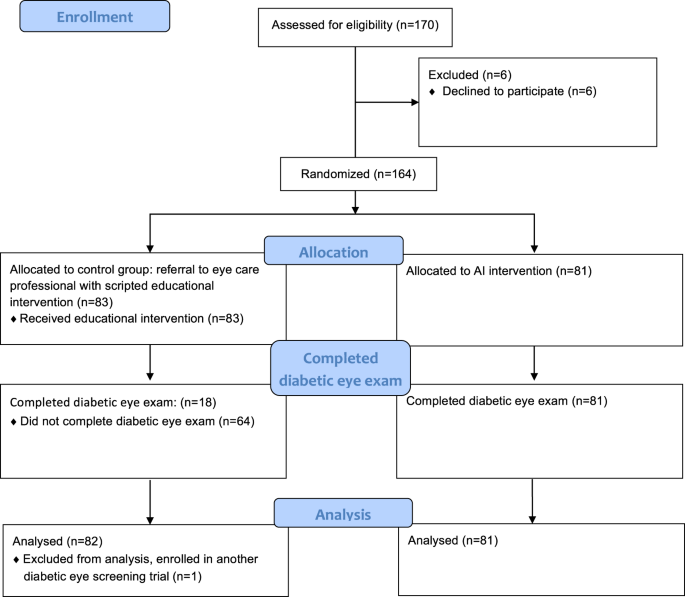
completed in the referral-plus-education control arm.
completed in the point-of-care autonomous-AI arm.
Primary outcome
Completion of recommended screening—not AUROC.
Wolf et al. (2024), Fig. 1, reproduced under CC BY 4.0. (Wolf et al. 2024)
What changed in ACCESS?
Referral pathway
Point-of-care pathway
The intervention bundled co-location, image acquisition, autonomous interpretation, an immediate result, education, and referral when indicated.
Defensible claim: the bundled pathway increased screening completion in this trial.
Not established: which component caused how much of the effect, or whether long-term visual outcomes improved.
Question
Was the algorithm the intervention, or did the algorithm enable the intervention?
Widespread deployment is not evidence
🔗 Sepsis is common, time-sensitive, and potentially actionable. The Epic Sepsis Model was already implemented at 100s of US hospitals when independent external validation reported much weaker performance than expected. (Wong et al. 2021)
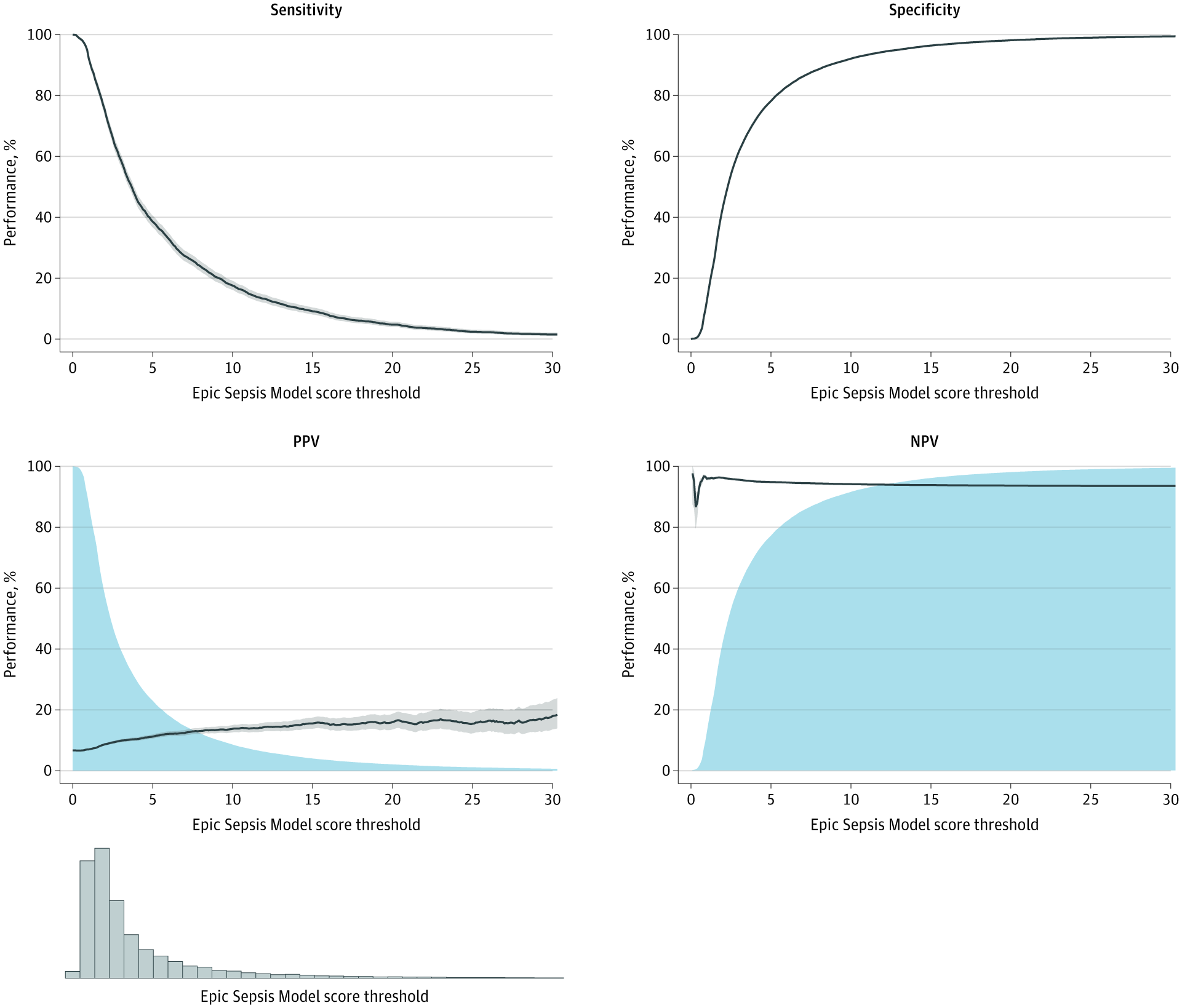
Hospitalization-level AUROC: 0.63
At the operational threshold \(\mathrm{ESM}\geq 6\):
- sensitivity 33%
- specificity 83%
- positive predictive value 12%
- negative predictive value 95%
Lifecycle mistake
Neither availability inside the EHR nor preponderance is independent evidence of clinical value.
Wong et al. (2021), Fig. 1. (Wong et al. 2021)
Incremental value and alert burden
At the same threshold, the model:
of hospitalizations crossed the threshold at least once.
of sepsis hospitalizations were not identified.
of sepsis hospitalizations crossed the threshold without timely antibiotics already given—the study’s potential incremental-detection group.
If clinicians repeatedly evaluated alerts for sepsis in the next four hours, the study estimated 109 evaluations for one patient with sepsis. (Wong et al. 2021)
The real comparison
A clinical model should be compared with contemporary care and evaluated in terms of added information, timing, workload, and consequences.
Four category mistakes
Target mistake
The model optimizes the target correctly, but the target is not the clinical purpose.
Benchmark mistake
Performance in a curated dataset, vignette, or simulation is treated as performance in use.
Metric mistake
A summary score is treated as sufficient evidence for a decision and workload.
Lifecycle mistake
A deployed model is treated as stable, validated, and finished.
These four mistakes will recur throughout the class. See if you can spot them!
Primum non nocere (and do not ignore inaction)
Machine learning can support diagnosis, prognosis, triage, documentation, monitoring, and operations.
It can also introduce new failure modes, shift work, obscure accountability, or scale inequity. (Wiens et al. 2019; Cabitza, Rasoini, and Gensini 2017)
Clinical case
The relevant comparison is rarely “AI versus perfection” (or it shouldn’t be), but instead the proposed human–technology workflow versus the current workflow, including the risks of doing nothing.
Why operationalized ML?
Healthcare decisions are made under uncertainty, time pressure, incomplete records, changing evidence, human fallibility and constrained resources.
A useful system must therefore connect:
- a real decision;
- data available at the decision time;
- a model that generalizes;
- an interface that fits work;
- an action that can improve outcomes;
- monitoring and governance across time.
The field goes beyond model accuracy in the lab to also include socio-technical performance.
Workload and burnout
Clinical documentation and coordination burdens matter, but “AI will reduce burnout” is not a sufficient hypothesis (Seth, Carretas, and Rudzicz 2024).
Ask instead:
- Which task is reduced or shifted?
- Who reviews, corrects, or explains the output?
- Does alerting add interruptions?
- Does the tool create new documentation or liability work?
- How will time, cognitive load, and downstream effort be measured?
Legacy evidence on physician burnout and empathy remains useful context, while modern evaluation must measure the actual workflow. (Shanafelt et al. 2015; Riess et al. 2012; Beede et al. 2020)
Decisions under uncertainty
Clinicians combine imperfect information:
- history and patient report;
- examination;
- labs, imaging, waveforms, and notes;
- prior records and population evidence;
- contextual knowledge and team communication.
Models also operate on imperfect inputs, but their errors can be systematic, difficult to notice, and repeated at scale.
Should this be an ML problem?
Before modelling, inspect the bottleneck.
A non-ML intervention may be better when the problem is:
- unavailable or poorly displayed information;
- an unnecessary handoff;
- a standard process that is not followed;
- an unreliable measurement or label (though maybe…);
- a decision already handled by a transparent rule.
ML becomes plausible when:
- uncertainty remains after reasonable process repair;
- earlier or more individualized estimates could change action;
- inputs exist by the decision time;
- an intervention is feasible;
- errors and workload can be evaluated;
- the proposed gain justifies complexity and governance.
ACCESS is instructive because the AI enabled a bundled point-of-care pathway that helped. The trial establishes the effect of that bundle, not just the algorithm in isolation.
Prediction is not the decision
| Model output | Decision question |
|---|---|
| 18% SSI risk | Is enhanced monitoring worthwhile? |
| ranked differential | Which diagnoses should be investigated next? |
| predicted length of stay | How should beds and staffing be planned? |
| generated discharge summary | Is the content accurate, complete, and safe to sign? |
| deterioration alert | Who responds, by when, with what protocol? |
Pause and discuss
A model output has no clinical value until it is connected to an action, resource, and accountable user.
Prediction, explanation, experimentation
Three questions often get confused:
- Prediction: Who is likely to experience SSI?
- Explanation: Which observed patterns contributed to the model score?
- Experimentation/causation: Which intervention would reduce SSI for this patient?
Warning
A predictive feature can be useful without being causal. A causal factor may be hard to predict. A post-hoc explanation may not reveal the true mechanism.
Every decision changes the study
- Population: all cardiac surgery, CABG only, first procedures, adults, one site?
- Index time: scheduling, admission, incision, skin closure, ICU transfer, discharge?
- Cut-off: what data are genuinely available and finalized?
- Outcome: superficial SSI, deep sternal wound infection, mediastinitis, any infection?
- Horizon: in-hospital, 30 days, 90 days?
- User/action: surgeon, nurse, infection prevention, follow-up clinic, patient?
Risk
Changing the intended use after seeing model performance is a form of 🔗 outcome-driven design.
SSI is not one label
(See Section 4.0.5).
Cardiac surgical-site outcomes can differ by tissue depth, anatomic site, surveillance period, and evidence used to establish the event. Current surveillance protocols should anchor definitions and adjudication. (Centers for Disease Control and Prevention 2026)
Potential targets include:
- superficial incisional SSI;
- deep incisional SSI;
- sternal osteomyelitis;
- mediastinitis;
- composite “any SSI”;
- time to first qualifying event;
- need for reoperation or prolonged antimicrobial treatment.
Pause and discuss
A clinically meaningful target can still be unsuitable if ascertainment is inconsistent or follow-up is incomplete.
Task taxonomy
| Task | Example output | Typical evaluation |
|---|---|---|
| Classification | SSI within 30 days: yes/no | sensitivity, specificity, AUROC, AUPRC |
| Risk estimation | 0.18 probability | calibration, Brier/log loss, utility |
| Ranking | prioritized follow-up list | precision at k, workload, capture rate |
| Regression | predicted ICU hours | MAE/RMSE, calibration of intervals |
| Survival | infection-free probability over time | C-index, time-dependent calibration |
| Trajectory | evolving risk across pathway | dynamic discrimination/calibration |
| Generation | summary or recommendation text | factuality, completeness, harm, workflow |
Static versus dynamic prediction
🔗 Static-vs-dynamic prediction basically refers to whether the predictions are done ‘offline’ (often in batches) or ‘online’ (often on demand).
- Are the following static or dynamic?
- A pre-operative model can support planning.
- An end-of-surgery model can incorporate procedure and physiology.
- A ward model can update risk using wound, temperature, labs, and notes.
Model principle
Dynamic prediction is not simply “add more variables.” It requires clear landmark times, time-varying availability, repeated-measure handling, and evaluation that respects time.
RCTs answer a different question
Randomized trials estimate effects of interventions under defined conditions.
Prediction-model studies estimate how well outcomes can be forecast in a target population or scenario.
A prediction system may ultimately need several forms of evidence:
- retrospective model development;
- external validation;
- prospective silent evaluation;
- human-factors evaluation;
- comparative impact study;
- post-deployment surveillance.
Reporting frameworks distinguish these stages rather than treating one held-out test set as completion. (Vasey et al. 2022; Liu et al. 2020; Rivera et al. 2020)
Match the claim to the evidence
| Claim | Evidence that begins to support it |
|---|---|
| The model distinguishes outcomes | held-out discrimination with uncertainty |
| Predicted risks are meaningful | calibration and proper scoring rules |
| It travels to another setting or time | temporal or geographic external validation |
| People can use it safely | usability and human-factors evaluation |
| It changes care | prospective workflow or comparative impact evaluation |
| It improves patient outcomes | an impact design appropriate to the intervention, sometimes randomized |
| It remains safe | monitoring, incidents, change control, and retirement criteria |
No single study proves ‘the system works’
Different claims require different evidence.
Exercise · turn a promise into a study
A team proposes:
“We will use AI to reduce surgical-site infection after cardiac surgery.”
1 · Need: What current care gap are they trying to change?
2 · Intended use: Who, when, what outcome, what horizon, and what action?
3 · Non-ML alternative: What process or measurement repair should be considered first?
4 · Claim: What is the smallest claim the first study could honestly support?
5 · Failure: Which of the four category mistakes is most likely?
Debrief · a defensible starting point
One reasonable first goal may be:
Among adult cardiac-surgery patients at ICU transfer, estimate 30-day superficial-SSI risk using information available by that time, and evaluate whether the estimate is sufficiently calibrated and timely to justify a later prospective study of enhanced surveillance.
This does not yet claim that:
- the model reduces SSI;
- the proposed surveillance is effective;
- a decision threshold is acceptable (risk-wise);
- the system works well beyond the development setting;
- the workflow is safe or feasible.
References

DGIN 5401 · Operationalized ML in Healthcare