Appendix: Technical Notes
This hypertext is written in Strict XHTML
1.0 with Cascading Style Sheets version 2, without any
dynamic content (i.e., client- or
server-side scripting) so it should be rendered reasonably well
by any conforming browser.
XHTML tables have been used but only for
presenting tabular data and the navigational aids at the
beginning and end of each text chunk.
Where entities have been used for content (e.g — for a
punctuation dash, or § for a section symbol)
they have been used by name so that browsers that cannot display
the symbol should preserve the meaning of the markup by
presenting the name to readers.
Where non-breaking spaces have been required they have been
encoded as numeric entities ( ) so as not
to unnecessarily distract readers.
Although these precautions have been taken the document has only
been viewed with Netscape 7.1 for the Macintosh on a regular
monitor (not a handheld device).
Link Types
Redundant information has been encoded into link types [Trigg & Weisner, 1986;
Campbell & Maglio,
1999] to help readers to determine if they should follow the
links during a first reading, on a subsequent reading, or never.
The link formatting has been chosen so the types can be
distinguished from each other and ordinary text, and yet not be
intrusive or distracting [Bernstein,
n.d.; Campbell & Maglio, 1999].
Cascading Style Sheet Rules
CSS rules have
been used to show different link types in visual browsers. The
three types are:
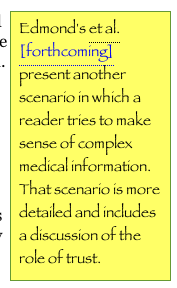
- 1. Links to individual works referenced in the the article
- should have dotted underlines in the usual colours
- Two example images
- a. Citation in line

- b. Citation in a marginal note (note background colour and font)
- 2. Links to resources outside of this article (e.g., at the ACM's
Digital Library)
- should be underlined as usual
- One example image

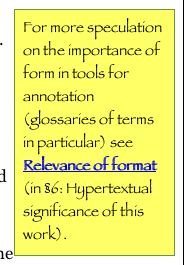
- 3. Non-citation links to parts of this article
- are underlined as usual but the text should be in
boldface
- Three example images
- a. Navigational link in the body of the article

- b. Navigational link at the start and end of a text chunk (note the background colour)

- c. Cross-reference link in a marginal note
The exact presentation will depend on the reader's browser
software and its configuration.
References
References for works cited in this text chunk appear below.
References for all works cited are available in a separate chunk.
- [Bernstein, n.d.]
-
Mark Bernstein.
showing links.
HypertextNOW.
(No publication date given but copyright 2003. Certainly was
online circa 1998.)
-
<URL:http://www.eastgate.com/HypertextNow/archives/ShowingLinks.html>.
- [Campbell & Maglio, 1999]
-
Christopher S. Campbell, and Paul P. Maglio.
Facilitating navigation in information spaces: Road-signs on the
World Wide Web.
International Journal of Human-Computer Studies, 50(4):309
– 327, 1999.
- <DOI:10.1006/ijhc.1998.0246>.
- [Trigg & Weisner, 1986]
-
Randall H. Trigg and Mark Weisner.
TEXTNET: A Network-Based Approach to Text Handling.
In ACM
Transactions on Office Information Systems,
4(1):1 –23, January, 1986.
-
<DOI:10.1145/5401.5402>.
 &
&  .
.
[Up to navigation links]