A recommendation history describes what someone wanted before. It does not necessarily describe what they want now. A person who usually watches crime dramas may ask for “something sweet and heartwarming” tonight; a music listener may want to avoid a familiar genre for one session. CRAMER lets a user express that immediate preference in natural language and edits the recommender’s behavior without retraining its backbone.
How can a deployed recommender reconcile a person’s long-term interaction history with a new request quickly, precisely, and without asking a large language model to rerank every candidate?
Preference adaptation as model control
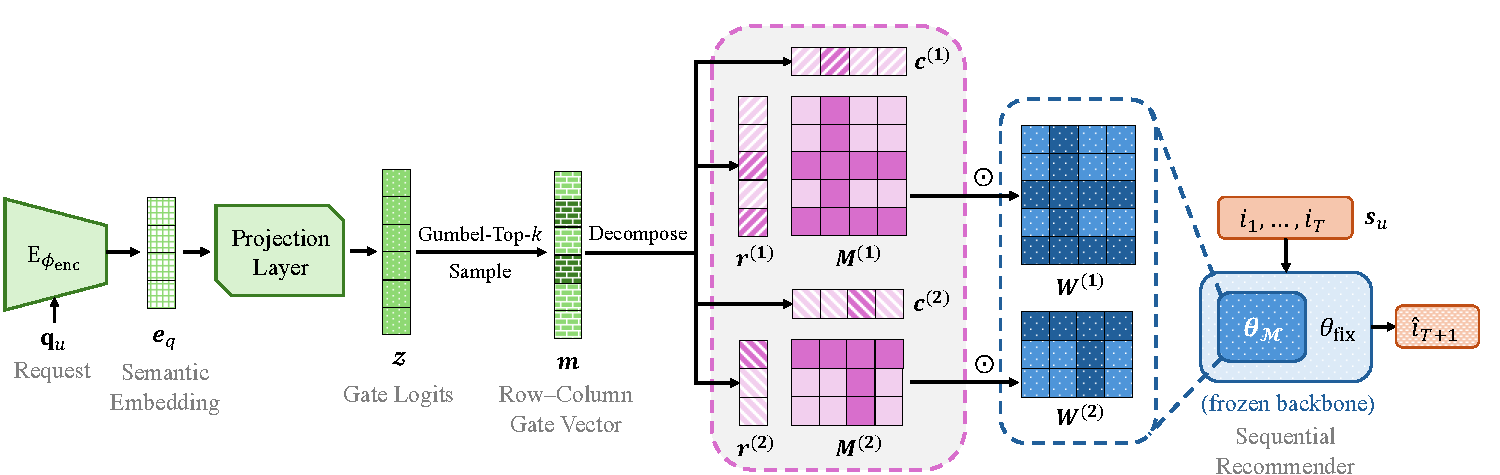
Conventional sequential recommenders predict the next item from an interaction sequence su. CRAMER adds a natural-language request qu, but it does not simply concatenate that text to the input or use it to filter a finished list. Instead, a learned controller maps the request to a control signal that edits selected parameters of the frozen recommender:
The backbone parameters θ stay frozen. Only the request encoder and projection components are learned. A user request is embedded, projected to gate logits, and passed through Gumbel-Top-k sampling to produce a hard, sparse control vector. This makes each edit both request-specific and computationally bounded.
A mask instead of a new model
Masking every individual parameter would make the controller almost as unwieldy as the backbone. CRAMER therefore chooses rows and columns of a weight matrix separately. Their outer product creates an entrywise mask:
A pair of short binary vectors controls an entire matrix. The paper applies these masks to feed-forward layers, attention-output projections, or both—compact intervention points in Transformer recommenders.
A pretrained language encoder captures direct, indirect, and negated preference language.
Gumbel-Top-k keeps an exact number of row and column gates active.
The masked SASRec or BERT4Rec model combines immediate intent with long-term behavior.
Does the model follow what the user says?
The paper tests semantic control using 100 users from the ReDial movie dataset. Without a request, an average of 28.6% of the top ten recommendations are romance-related. The authors then issue six natural-language requests: three asking for more romance and three asking for less. Every request moves the recommendation distribution in the intended direction.
This example makes controllability visible. The mask is not an arbitrary perturbation: positive, ambiguous, negative, and unusual formulations all cause semantically aligned changes. The strongest positive request raises romance representation from 28.6% to 43.2%; the clearest negative request lowers it to 13.5%.
Accuracy across models and domains
The evaluation spans four datasets—ReDial, KuaiSAR, Amazon Beauty, and Amazon CDs & Vinyl—and two frozen sequential-recommendation backbones, SASRec and BERT4Rec. It compares CRAMER with request augmentation, language-to-item representations, embedding enhancement, and LLM reranking.
Across 48 dataset, backbone, and metric combinations, CRAMER records the highest reported value in every setting. After the paper’s multiple-comparison correction, its improvement over the strongest baseline remains statistically significant in 41 of 48 settings (85.42%). The result holds across Hit Ratio, NDCG, and Mean Reciprocal Rank at cutoffs 10 and 20.
The runtime difference matters for an interactive system. In the paper’s SASRec experiment, CRAMER adds only 18 milliseconds per request, close to the lightest request-aware baselines. The LLM reranker adds more than nine seconds because it reasons over multiple candidates at inference time.
Preference is a conversation, not a static profile
CRAMER treats a recommendation model as something a person can steer after deployment. Historical behavior still supplies the durable preference signal, while language supplies a short-horizon correction: more of this, less of that, or something different for the present context. Structured masking connects those two signals without rebuilding the user profile or the recommender itself.
Read the research
- Zhiyuan Julian Su, Naihe Feng, Zhen Luther Qin, and Ga Wu. CRAMER: Control via Request-Aware Masking for Editing Recommenders, ICML 2026.
- Source code