Deleting a record from a dataset is easy. Removing what a trained model learned from that record is harder: a direct parameter update may erase the target, but it can also discard information shared with useful examples. PUMA—Performance Unchanged Model Augmentation—treats removal as a balancing problem. It subtracts the distinctive influence of marked data, then uses a sparse reweighting of remaining data to compensate for the performance that would otherwise be lost.
Do not ask only, “How do we reverse this example’s gradient?” Ask, “Which small combination of retained examples can counterbalance the performance shift caused by removing it?”
Two objectives, one careful update
PUMA separates the objective used to train the model, J, from the criterion we want the edited model to preserve, C. The criterion could measure predictive loss, calibration, or another differentiable property. If θorg is the original model and θmod is the model after removal, the design target is explicit:
The tolerance δ says how much movement in the chosen performance criterion is acceptable. Removal is therefore constrained by behavior, not merely by distance between parameter vectors.
Influence functions provide the local language for this calculation. For each training point (xj, yj), PUMA estimates how a small change in its weight would move the criterion:
The example gradient describes what the point teaches; the inverse Hessian accounts for local model geometry; ∇C turns the resulting parameter movement into a change in the behavior we care about.
Why simply reversing influence is not enough

The picture exposes a subtle failure mode. A marked example may contain both a unique characteristic that should disappear and shared signal that helps the model generalize. Negating its whole contribution removes both. PUMA instead searches among retained examples for influences that replace the useful shared component.
Estimate every candidate point’s effect on the chosen criterion C.
Find sparse, small weights on retained points that match the marked set’s performance contribution.
Subtract the marked influence and the compensating influence in one local parameter update.
The balancing weights are obtained by solving
The first term matches the criterion-level influence of the retained points to that of the marked set. Ω combines ℓ1 and ℓ2 regularization, encouraging a correction that is both sparse and small.
A visible removal test
The paper first tests the idea on a classifier with several clusters per class. The crossed green cluster is marked for removal. Before editing, the classifier recognizes it as green; afterward, PUMA assigns the region according to the surrounding orange observations. The other clusters retain their structure.

This is a stronger test than making a few marked predictions incorrect. It asks whether the model behaves as though the removed cluster’s distinctive pattern had not been available, while still retaining the broader decision structure learned from the rest of the data.
Removing a writing style, not the whole digit
The MNIST experiment makes that distinction concrete. The marked records are all images of the digit 4, but they share a particular handwriting style. Before removal, the original model classifies every marked image as 4 with confidence 1.00. After PUMA, those marked samples receive varied labels and lower confidence, while other styles of 4 remain correctly recognized.
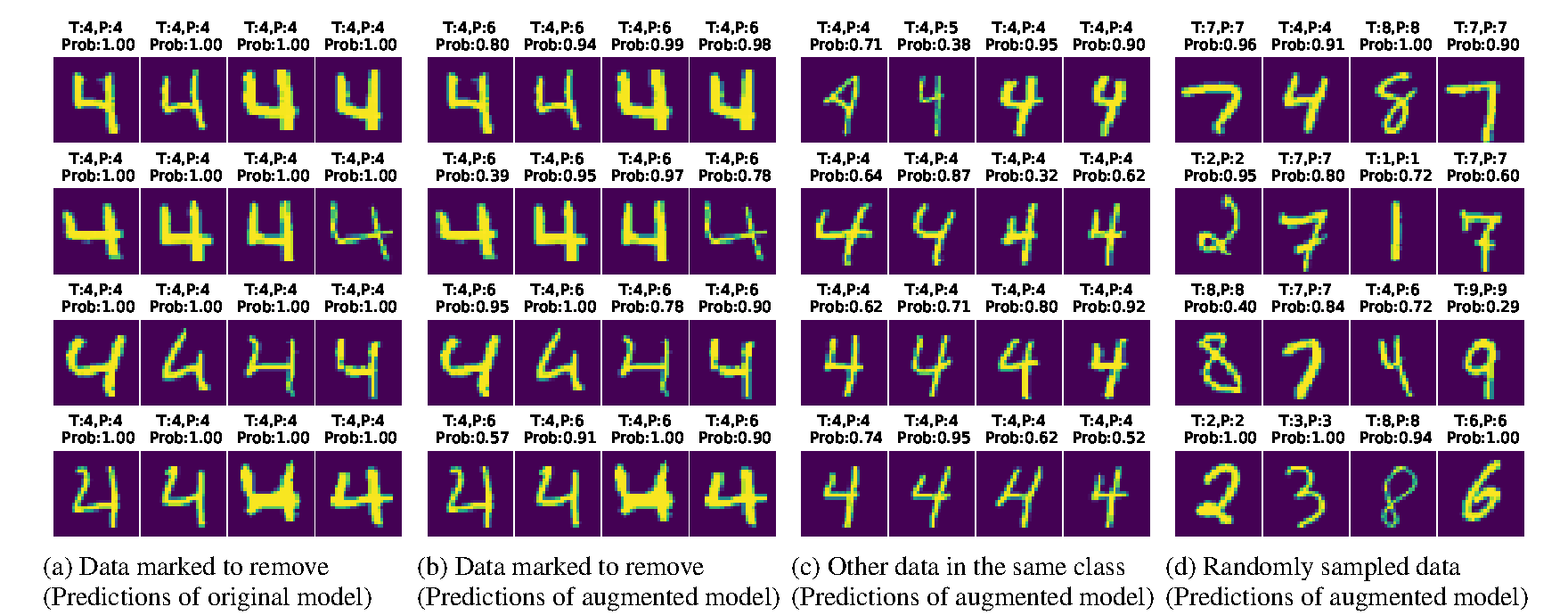
The comparison separates targeted removal from class-wide damage. The edit disrupts the selected visual signature without teaching the model to forget every 4. Randomly sampled digits are also still handled correctly, providing a visual check that the patch remains localized.
Evidence across removal settings
The evaluation spans synthetic data, UCI tabular datasets, and MNIST, with both ordered and randomly distributed removal requests. The authors examine two sides of the goal: whether removed examples evade a membership-inference attack, and whether the model retains predictive performance.
On MNIST under random removal, PUMA keeps accuracy between 97.42% and 97.61% as the removed fraction grows from 20% to 80%, compared with an original accuracy of 97.97%. In the same setting, the reported accuracy for SISA falls from 93.47% to 59.83%, while the tested Amnesiac ML configuration remains near 10%. Across the study, PUMA’s criterion-specific influence scores also identify mislabeled examples, turning the same calculation into a data-debugging signal.
Trust through controlled forgetting
PUMA frames training-data removal as a model-behavior problem. The marked data’s unique trace should disappear, but useful shared structure should remain. By naming a criterion, measuring each point’s contribution to it, and constructing a sparse counterweight before patching the model, the method makes that trade precise—and makes the result inspectable through both privacy attacks and retained performance.
Read the research
- Ga Wu, Masoud Hashemi, and Christopher Srinivasa. PUMA: Performance Unchanged Model Augmentation for Training Data Removal, AAAI, 2022.