A deployed model may receive many requests to forget: a withdrawn training image, a corrupted example, or an entire class that should no longer influence predictions. Retraining from scratch is expensive, while repeatedly fine-tuning the model can disturb behavior that should remain intact. Minimally Invasive Machine Unlearning (MIMU) takes a different route: learn a controller in advance, then fulfill each request by masking a small, targeted subset of weights.
Unlearning becomes a control problem, not a new optimization problem for every request. The predictive model remains frozen; a learned policy decides which parameters to switch off.
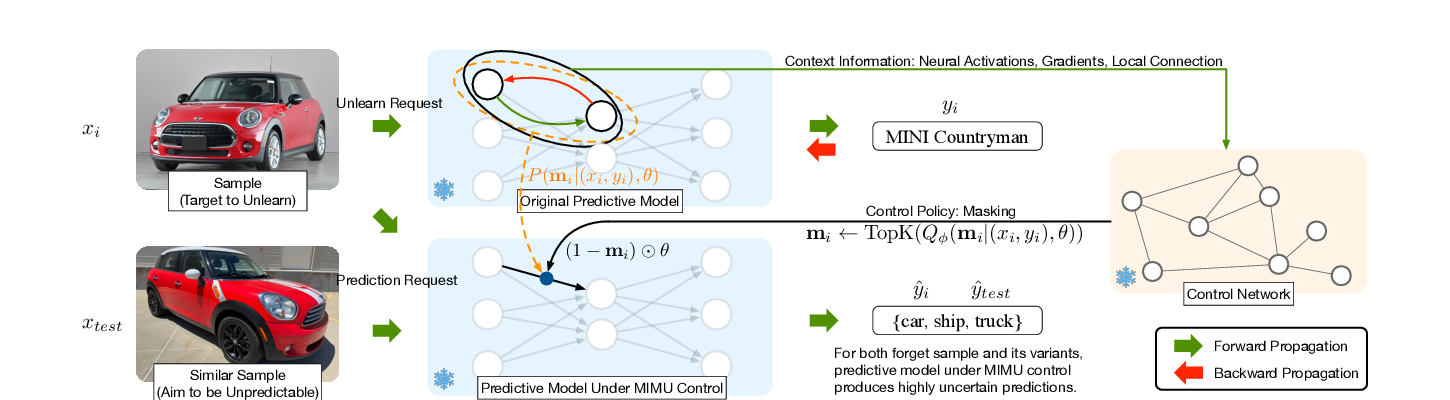
From a forget request to a sparse intervention
Let the trained predictor have parameters θ, and let m be a binary mask. The ideal request-specific masking policy is expensive to compute directly, so MIMU trains a parameterized controller Qφ to approximate it while enforcing an exact intervention budget:
The controller learns to match the ideal masking distribution P, while the ℓ0 constraint fixes each intervention to exactly δ selected parameters.
| Instead of solving this combinatorial search after every request, the method learns a distribution Qφ(m | x, y, θ) over masks ahead of time. Top-δ sampling turns that distribution into an exactly sparse binary action. At request time, the controller only needs a forward pass, feature extraction, and mask application. |
Collect the request and local activations, gradients, weight values, and connectivity.
The pretrained controller scores parameters and returns a sparse top-δ mask.
Mask those weights so the target becomes unpredictable while retained behavior stays stable.
Why a graph controller?
A weight does not act alone. Two parameters are related when they meet at the same neuron, and their effect depends on the activations and gradients around them. MIMU therefore represents a selected neural-network layer as a graph: weights become nodes, and weights incident to a shared neuron are connected.
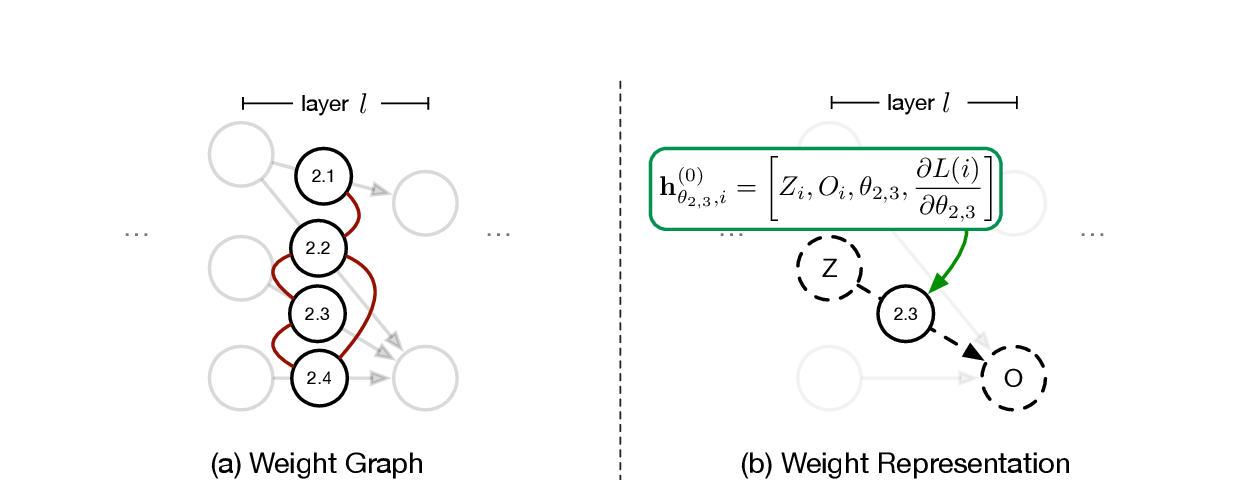
This representation lets the controller learn interactions among nearby parameters rather than ranking every weight independently. The masking prior also favors influential weights by assigning probability in proportion to magnitude:
The learned posterior combines this prior with request-specific evidence. Gumbel top-k sampling makes the hard, fixed-size mask trainable with gradient descent.
Forget by becoming uncertain
Making a model confidently predict the wrong class is not the same as removing predictive information. MIMU instead pushes the forget examples toward high predictive entropy. For retained examples, the objective is the opposite: preserve confident predictions and preserve the internal evidence used to make them.
The experiments cover class-level and subclass-level requests on MNIST, Fashion-MNIST, CIFAR-10, and ImageNet-100, using models from an MLP through ResNet-50. In the reported class-level experiments, MIMU reduces forget-set accuracy to approximately zero across all four datasets while keeping retain-set degradation within two percentage points.
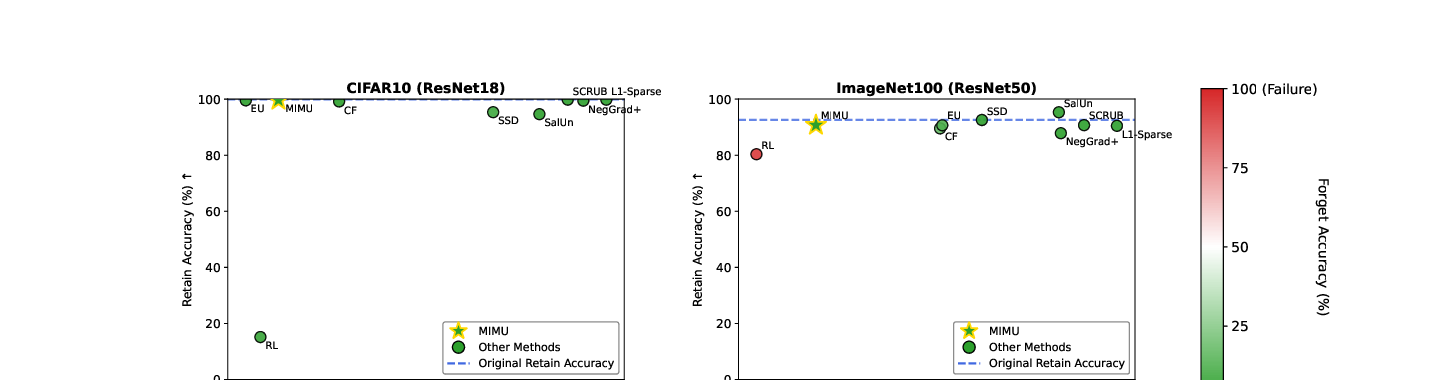
On ImageNet-100 with ResNet-50, the paper reports 9.18 ± 2.08 seconds per MIMU request. By comparison, NegGrad+, Saliency Unlearning, and SCRUB take roughly 2,036, 1,948, and 3,395 seconds respectively in the same table. The controller has an up-front training cost, but that cost is shared across subsequent requests.
What “minimally invasive” looks like inside the model
Accuracy alone cannot reveal whether retained predictions are now based on different or spurious evidence. The authors therefore compare input saliency before and after unlearning. Red pixels in the figure mark locations whose saliency changed substantially.
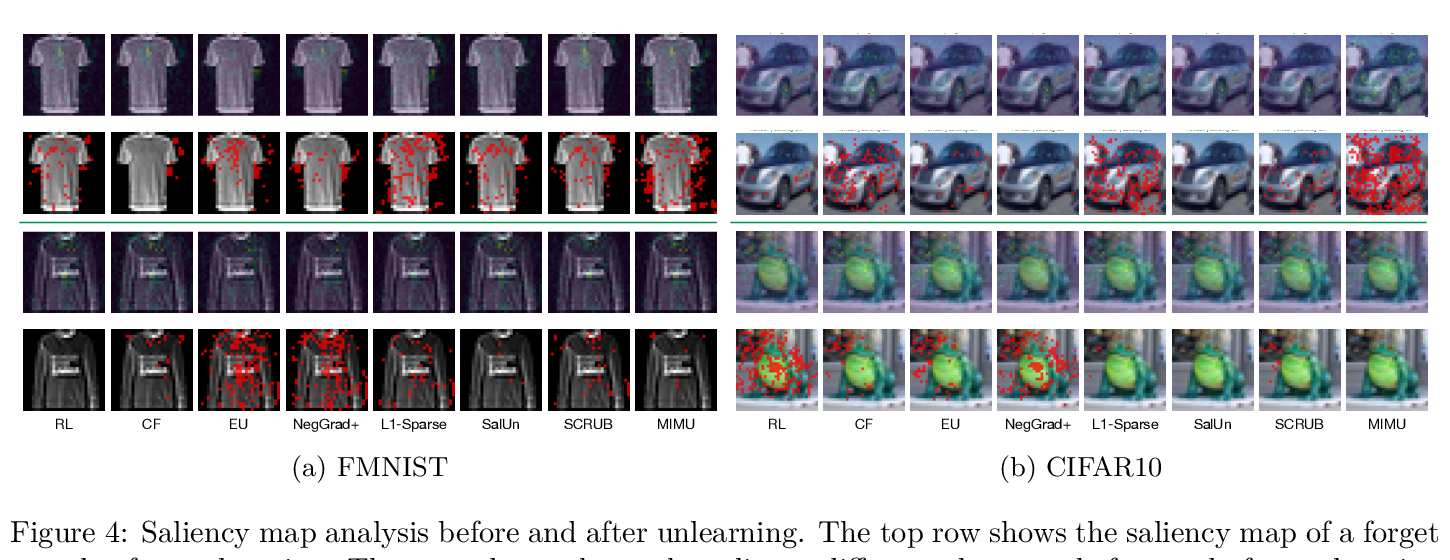
The saliency result completes the story behind the accuracy numbers. The controller is not merely keeping the final label unchanged on retained data; it largely preserves the prediction pattern that produced that label. For forget data, the opposite behavior is desirable: the marked shift shows that the targeted predictive pathway has been disrupted.
A reusable control layer for deployed models
MIMU separates two timescales. During training, it learns how examples, gradients, and parameter connectivity predict an effective intervention. During deployment, it converts each new request directly into a sparse mask. That separation makes repeated unlearning requests look less like repeated model repair and more like fast, structured model control.
Read the research
- Matthew Young, Valentin Villecroze, Sujay Menon, Mahtab Sarvmaili, Cheng Chang, Himanshu Rai, Ga Wu, and Maksims Volkovs. Minimally Invasive Machine Unlearning via Posterior Control, Transactions on Machine Learning Research, 2026.