Most self-supervised learning methods begin by deciding which changes should leave meaning intact: crop an image, perturb a signal, or corrupt a table. That decision quietly embeds domain knowledge into the learning pipeline. Learning from Randomness (LFR) asks whether useful representations can be learned without designing those transformations at all—by training an encoder to reconstruct the outputs of several frozen, randomly initialized networks.
If a compact representation can support many diverse and unpredictable projection tasks through simple prediction heads, then it must preserve rich information about the original input.
When an augmentation changes the meaning
Augmentation-based self-supervision assumes that two transformed views describe the same underlying object. That works when invariances are known. In specialized domains, however, common transformations can produce samples that are unrealistic or physically impossible.

The same problem appears elsewhere. Shifting a highly periodic time series may create uninformative duplicate views. Swapping tabular features can violate dependencies such as conservation laws. A generic method should not need a new augmentation theory for every modality and application.
Random networks become pretext tasks
LFR uses three sets of functions. An encoder fθ maps each input x to a compact representation z. Frozen random projectors g(k) produce pseudo-targets directly from the input. Small trainable predictors h(k)φ try to reproduce each pseudo-target using only z.

The joint objective sums reconstruction error across examples and projectors:
The projectors are random and frozen. Only the representation model and simple prediction heads are optimized. Limiting predictor capacity prevents each head from solving its task without relying on a useful shared representation.
Learning instance structure, not merely matching vectors
A simple mean-squared error can underweight subtle distinctions. LFR instead introduces Batch-wise Barlow Twins, which forms a cosine-similarity matrix between random targets and predicted targets across examples in a minibatch:
The diagonal term matches every example to its own pseudo-target. The off-diagonal term prevents different examples from becoming interchangeable, preserving instance-level structure in the representation.
Training alternates between updating the encoder and updating the predictor heads, following an expectation-maximization interpretation. Keeping one side fixed while optimizing the other stabilizes learning; the predictors receive several update steps so they remain useful evaluators of the current representation.
Hold the predictors fixed and improve the representation for all random tasks.
Hold the encoder fixed and fit each simple head to its frozen projector.
Repeat so neither side outruns the other and destabilizes the objective.
Diversity makes randomness informative
Several random projectors may accidentally respond to the same aspects of the data. LFR generates a larger candidate pool and selects a diverse subset by comparing the pairwise similarity patterns they induce over a representative batch. It also encourages different initial filters through Beta-distributed weights and frozen weight dropout.
This diversity is essential: each projector should ask a meaningfully different question of the representation. In the Kvasir ablation, applying diversity encouragement during both initialization and selection produces the strongest downstream accuracy.
One method across three modalities
The experiments use time-series, tabular, and image data from healthcare, banking, activity recognition, particle physics, and other scientific settings. The same basic LFR framework is used throughout; only the network architecture needed to consume each modality changes.
Activity, neurological, and clinical signals.
Social, logical, and particle-physics data.
Medical endoscopy imagery.
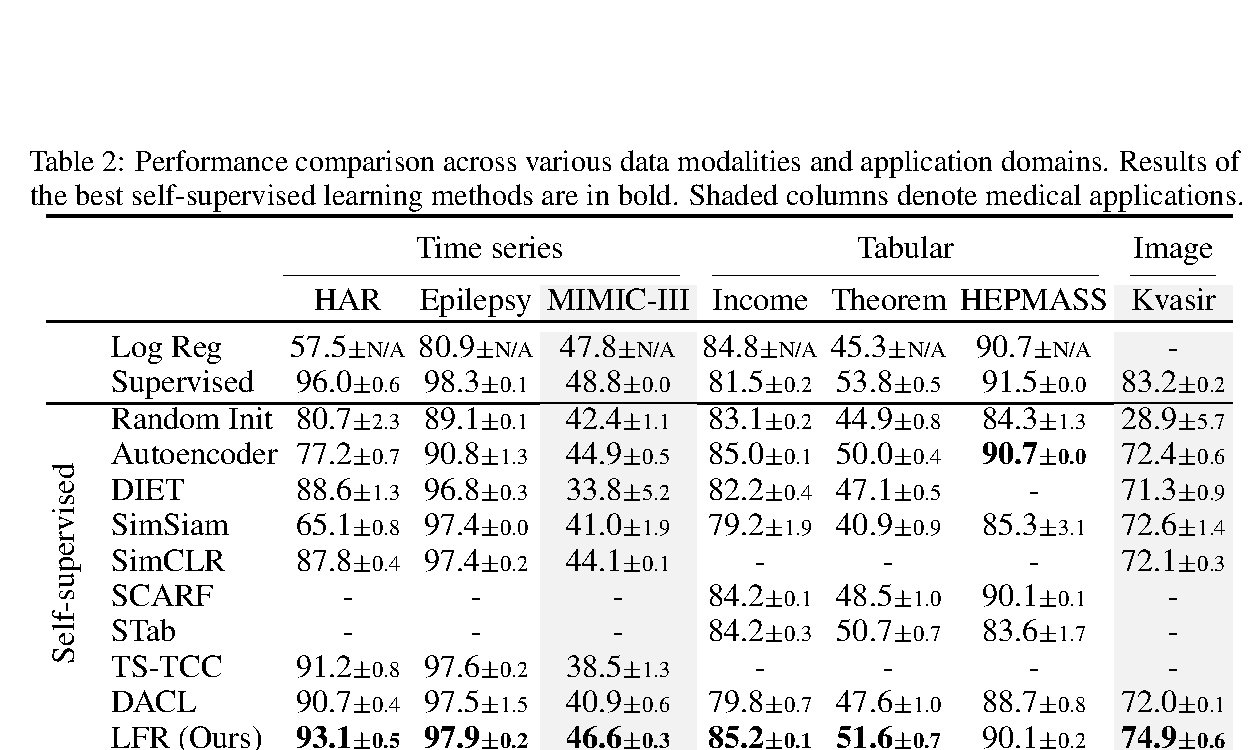
LFR reaches 93.1% on HAR, 97.9% on Epilepsy, 85.2% on Income, 51.6% on Theorem, and 74.9% on Kvasir. On the Income dataset, its linear evaluation even exceeds the paper’s supervised baseline. On the two medical benchmarks, it leads the self-supervised comparison on Kvasir and remains close to the best methods on MIMIC-III.
A different source of supervision
LFR does not claim that each random projector captures a meaningful human concept. Meaning emerges from the shared constraint: one compact representation must preserve enough structure for simple heads to solve many diverse tasks simultaneously. The randomness supplies breadth; the bottleneck and prediction heads force the encoder to organize that breadth into reusable features.
The result broadens where self-supervised learning can be applied. When trustworthy augmentations are obvious, invariance remains powerful. When the data’s valid transformations are unknown, expensive to design, or scientifically constrained, random projectors offer another route to useful representation learning.
Read the research
- Yi Sui, Tongzi Wu, Jesse C. Cresswell, Ga Wu, George Stein, Xiao Shi Huang, Xiaochen Zhang, and Maksims Volkovs. Self-Supervised Representation Learning from Random Data Projectors, ICLR 2024.
- Source code